How much time do young people really spend on screens — and what does this mean for their mental well-being?
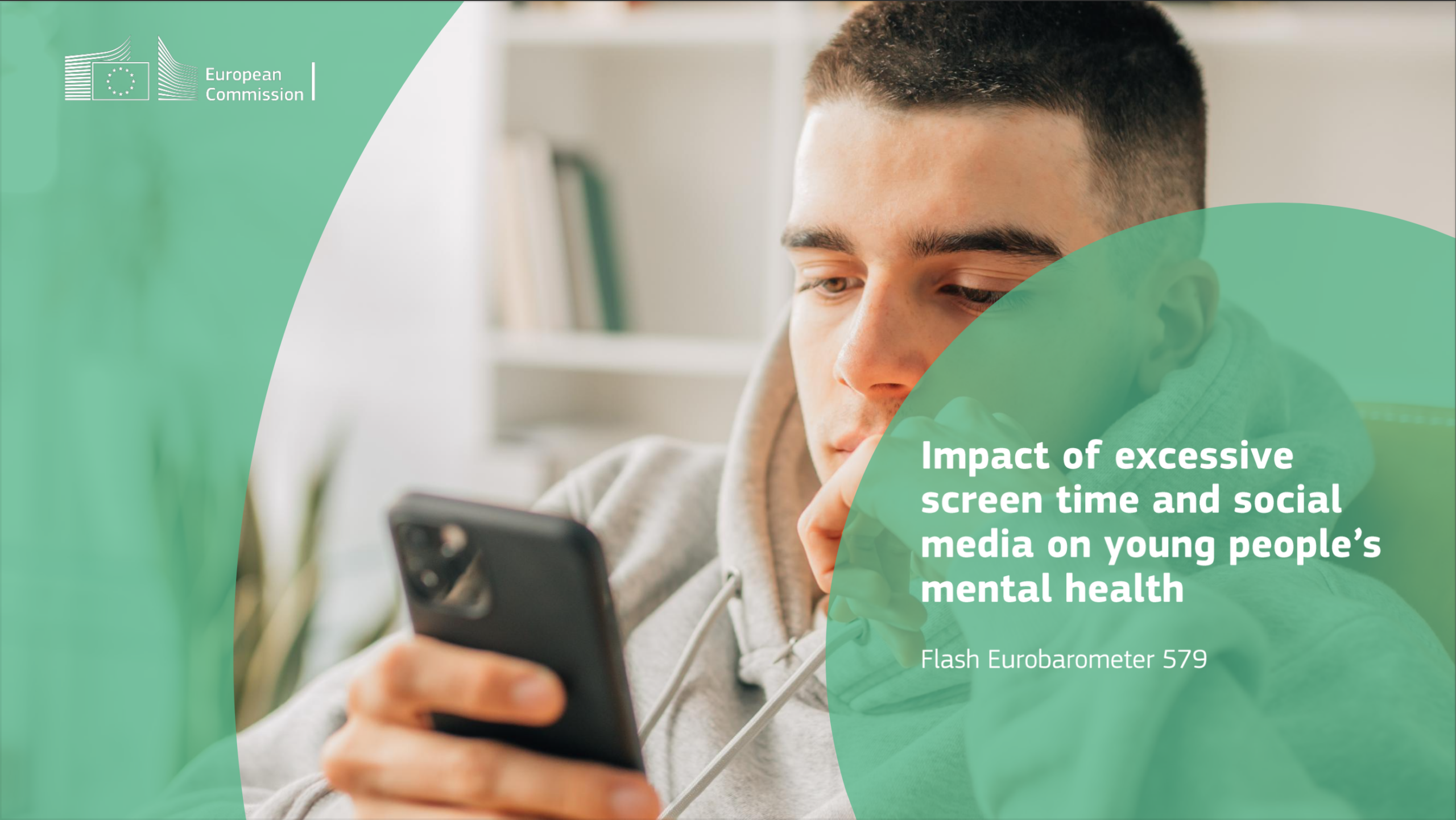
Flash Eurobarometer 579 explores screen use and social media habits among adolescents, their relationship with mental health and well-being, and the sometimes striking differences between how young people and their parents perceive these effects.
Here are some of the key findings from this study conducted by Demoscopy on behalf of the European Commission.
Key findings
- Adolescent screen time is heavy: teens spend an average of 4.5 hours on screens on a school day and 6.1 hours on a weekend day, with 46% spending more than six hours a day on screens during weekends.
- Parents underestimate this by close to an hour (3.4h on school days and 5.3h on weekends). Screen time rises sharply with early entry into social media: 7.5h on a weekend day for those who started before age 10, compared with 5.7h for those who started after age 14. This suggests a strong association between early social media use and heavier screen exposure, though the comparison with other predictors, such as the age at which the child received a smartphone, should be clarified before presenting it as the strongest factor.
- Parental concern concentrates on acute external threats — harmful content (72%) and online strangers (61%) — more than on longer-term effects such as sleep (54%) and school performance (51%). Yet the relationship with screen-use intensity points in the other direction: sleep problems rise from 18% among light users to 44% among heavy users.
- Adolescents and parents have very different perceptions of social media’s impact on young people’s mental well-being. Among adolescents, 48% report a positive effect and 18% a negative one, while among parents, 21% see a positive effect and 36% a negative one. A significant share of adolescents therefore already report a negative impact on their own well-being, while 42% call for better access to mental health support.
- Despite these differences, there is a cross-generational mandate for action: 47–48% of both groups want stronger enforcement of platform rules. Parents are more likely to support age limits (54% vs 45% of adolescents), while adolescents are more likely to call for better access to mental health support (42% vs 26% of parents).
Early entry into social media is associated with heavier screen time, which in turn is associated with higher levels of mental health symptoms, with social media showing the strongest dose-response relationship among the digital activities examined. Parents partly miss this chain, focusing more on acute external risks than on longer-term effects on sleep and concentration.
Despite their different perceptions, adolescents and parents converge on three key levers: better implementation of existing platform rules, age limits, and improved access to mental health support.
More info
- Screens and mental health of young people mental health_FL579_presentation_en
- Screens and mental health of young people mental health_FL579_infographic_en
- The full story here
What is Flash Eurobarometer?
Flash Eurobarometer surveys are ad-hoc, rapid data-collection studies commissioned by services of the European Commission (and, where relevant, the European Parliament) to measure public attitudes and stakeholder opinions across the EU. They provide swift, comparable insights covering both general population and specific target groups (e.g., SMEs, sector professionals…) using different data collection modes.
About Demoscopy
Demoscopy is a Brussels-based coordination centre specialising in large, multi-country opinion research for public institutions, academic research centres and international organisations. The company focuses on end-to-end orchestration (governance, methodology, quality assurance, and delivery) ensuring comparability, speed, and compliance across complex, multinational studies.
www.demoscopy.com / www.ifop.com / www.cint.com
Media contacts
Press & Media Relations – Demoscopy Consortium
Contact